Hangzhou's Dehumidifier Manufacturing Cluster: What Buyers Should Know
- Share
- publisher
- East Dehumidifier Technical Team
- Issue Time
- Sep 28,2026
Summary
Why Hangzhou, China concentrates industrial dehumidifier manufacturing — and how overseas B2B buyers should verify a factory, navigate the Ningbo and Shanghai ports, and turn the OEM cluster to their advantage.
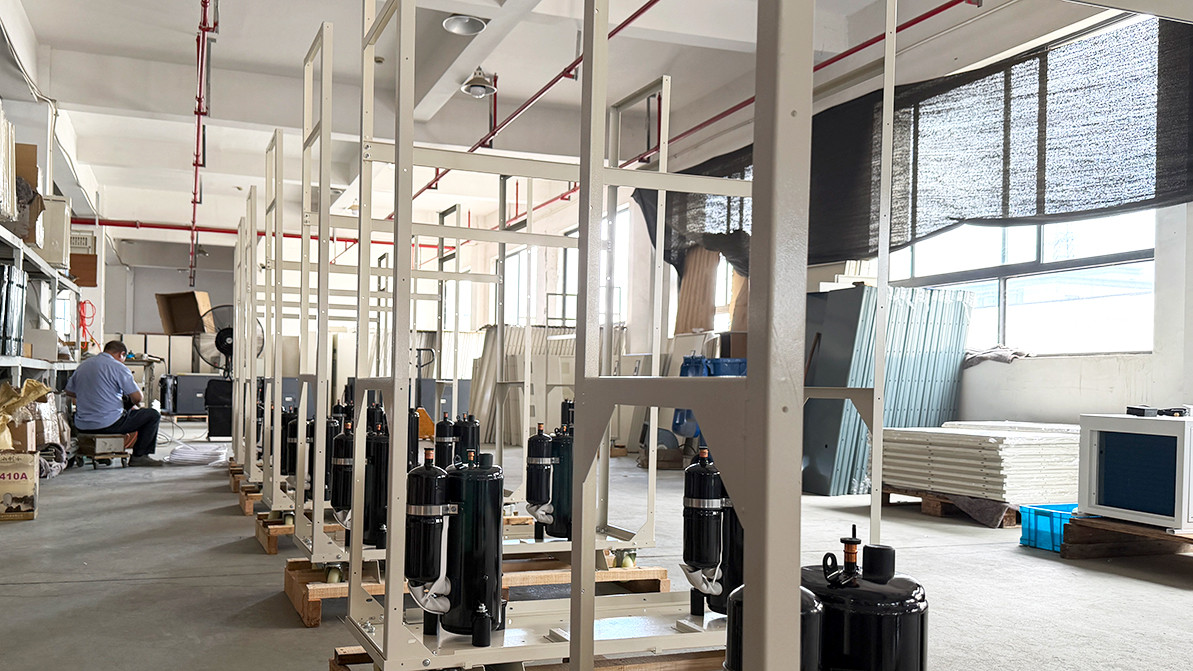
Search for an industrial dehumidifier factory and one city keeps coming up: Hangzhou. This is not a fluke of SEO — it is a genuine industrial cluster. But a cluster is a double-edged thing for a buyer. It concentrates capability and it concentrates resellers, brokers and trading companies that look like factories. This guide explains what the cluster actually is, what it does well, and how to buy from it without getting burned.
1. Why Humidity-Control Manufacturing Concentrated Here
Hangzhou, the capital of Zhejiang Province, is a megacity of roughly 12.7 million people whose economy reached about 2.3 trillion yuan (around $330 billion) in 2025. It sits at the center of the Yangtze River Delta, one of the densest manufacturing regions in the world, where a component, a machine or an engineer is almost always a short drive away.
The concentration did not happen by accident. Zhejiang's "Double-Eight Strategy," laid down in 2003, deliberately paired advanced manufacturing with regional integration, science and technology investment, and environmental protection — and the province is still harvesting that groundwork two decades later. Hangzhou has led China's list of private enterprises for 23 consecutive years, with 38 companies on the national Top 500 Private Enterprises ranking.
A dense supply chain in one province
Humidity-control equipment is an assembly of compressors, heat exchangers, sheet-metal enclosures, desiccant rotors, fans and controllers. Zhejiang produces all of these locally. When a factory can source a compressor or a rotor within the same city, lead times drop and prototype iteration accelerates — which is precisely why custom and private-label work clusters here rather than in regions with thinner component bases.
Engineering talent and digital tools
Hangzhou is also a talent hub. Institutions like Zhejiang University feed a steady stream of mechanical, refrigeration and controls engineers into the local industry, while the city's digital economy — home to Alibaba and a large software sector — gives local factories unusually strong access to smart controls, remote monitoring and production-management tools.
Export infrastructure built in
Finally, the cluster is logistics-native. Two of the world's largest container ports — Ningbo-Zhoushan and Shanghai — are within a few hours' drive, which keeps inland freight costs low and shipment schedules predictable. We return to this in the logistics section.
2. Brand Makers vs Contract Makers
The first thing to understand is that not every Hangzhou dehumidifier company is the same kind of business. There are two fundamentally different types, and they serve different buyers.
Brand-first factories
These companies build and market their own consumer and commercial brands, in China and overseas. Some are large and long-established — one Hangzhou-based maker has been producing since 1999 and is a drafting unit for China's national dehumidifier standard, with reported ODM work for global names in HVAC and telecommunications. Their scale is impressive, but a brand factory's own roadmap can limit how deeply they will customize for a single private-label customer, and their brand can even compete with yours in the same market.
Contract (OEM/ODM) factories
These are built around flexibility: low or no MOQs, private labeling, custom specifications and fast turnaround. East Dahuan — the company behind East Dehumidifier — fits here. Founded in Hangzhou in 2013, it operates as an OEM/ODM contract manufacturer with a no-MOQ policy and a standard 15-day delivery offer. Its scope spans condensing units (floor stand, ceiling mounted, hand push and split), desiccant rotor units, and ultrasonic humidifiers — a breadth typical of contract makers that serve many industries at once.
Why the distinction matters
If you are building your own brand line with custom specs, a brand-first factory may treat you as a second priority — or your products may end up competing against their house brand. A contract maker's incentive is aligned with yours: your label, your specification, your market. Knowing which type you are talking to is the first and cheapest filter in shortlisting.
3. What the Cluster Does Well
Set aside the marketing for a moment. What does the Hangzhou cluster genuinely deliver, in measurable terms?
Speed and flexibility
Local factories routinely quote a 15-day delivery window for custom builds, versus the 8–14 weeks that build-to-order European desiccant units typically require. Combine that with no-MOQ policies — ordering a single custom unit to validate a market — and the cluster removes the two biggest barriers to testing a private-label line: upfront volume and long wait times.
Customization depth
Contract makers here will change more than a logo. Buyers routinely specify casing color and finish, refrigerant type, supply voltage and frequency, control protocol (BACnet, Modbus), and even a re-engineered airflow layout for a specific room geometry. This is the core of OEM/ODM, and it is what a pure reseller cannot offer.
Certification and compliance experience
Because the cluster exports globally, its serious factories are fluent in the paperwork: CE for Europe, CSA/UL/ETL for North America, ISO 9001 quality systems, and niche standards like GMP for pharma cleanrooms or GB50457-2019 for clean engineering. For a buyer, this means a factory that has already solved the compliance problem for other customers in your market — an experience premium you get almost for free.
4. What to Verify Before You Commit
The cluster's reputation is strong, but "Hangzhou" on a listing is not itself a guarantee. A meaningful share of companies advertising as "manufacturers" in Chinese B2B directories are actually trading companies that resell or subcontract. Verification is not optional — it is the difference between buying from a factory and buying from a middleman with a good website.
Factory or trading company?
Three signals separate them. First, the business license scope: a manufacturer lists production activities; a trading company lists import/export or agency services. Second, on-site machinery: a factory has production lines, a trading company has an office and a showroom. Third, direct access: a factory can put you on a live video call with the production supervisor or QC manager during working hours; a trading company routes everything through sales.
Paperwork that must check out
Use a structured checklist and verify each item against an issuing body, not just a certificate on the wall.
| Verification item | What to check |
|---|---|
| Business license | Name and registered address match; scope includes manufacturing |
| Export license | Valid customs/export registration for direct shipment |
| Quality system | ISO 9001 (or industry-specific) verified with the certifying body |
| Product certifications | CE / CSA / UL / ETL current and cross-checked against lab reports |
| QC structure | Documented IQC, IPQC and FQC processes, plus AQL sampling at final inspection |
| Testing equipment | Calibration records and a real in-house test lab |
| Capacity claims | Stated annual output vs. actual production logs |
| References | At least two verifiable international buyers in your industry |
Red flags that should stop you
- Refusal of photography or live video. Legitimate factories welcome documentation; refusal often hides a facility that does not match the profile.
- Unrelated product range. A "factory" that also sells furniture and textiles is almost certainly subcontracting.
- Expired or unverifiable certificates. Cross-check every certification with its issuing body.
- Pressure to skip sampling or rush payment. Any supplier pushing full payment before samples is not operating in good faith.
5. Logistics: Ports, Lead Times, Consolidation
Hangzhou's logistics advantage is one of the least discussed but most valuable parts of the cluster. Two of the world's largest container ports sit within reach, giving buyers choice on cost, speed and schedule.
| Dimension | Ningbo-Zhoushan | Shanghai |
|---|---|---|
| Container throughput (2024) | ~39.3 million TEU (+11% YoY) | ~51.5 million TEU (world's largest) |
| Typical terminal fees | ~$180–220 per TEU | ~$230–280 per TEU |
| Average customs clearance | ~8 hours | ~12 hours |
| Peak-season berth wait | ~12–16 hours | ~18–24 hours |
Figures are approximate, drawn from 2024 port performance reporting; actual costs and times vary with season and carrier.
Why Ningbo often wins on cost and speed
For most Hangzhou-origin shipments, Ningbo-Zhoushan is the default. It is the world's busiest port by cargo tonnage, with terminal fees roughly 15–25% lower than Shanghai and consistently faster clearance. Shanghai, meanwhile, offers the broadest carrier network and the most frequent sailings — useful for multi-route or time-critical orders.
Consolidation and LCL for small orders
Because the cluster supports no-MOQ and trial orders, buyers often start with LCL (less-than-container-load) or consolidated shipments. Ningbo's experience with inspect-then-load consolidation keeps small mixed consignments moving without full-container minimums — the practical bridge between a one-unit trial and a full-container reorder.
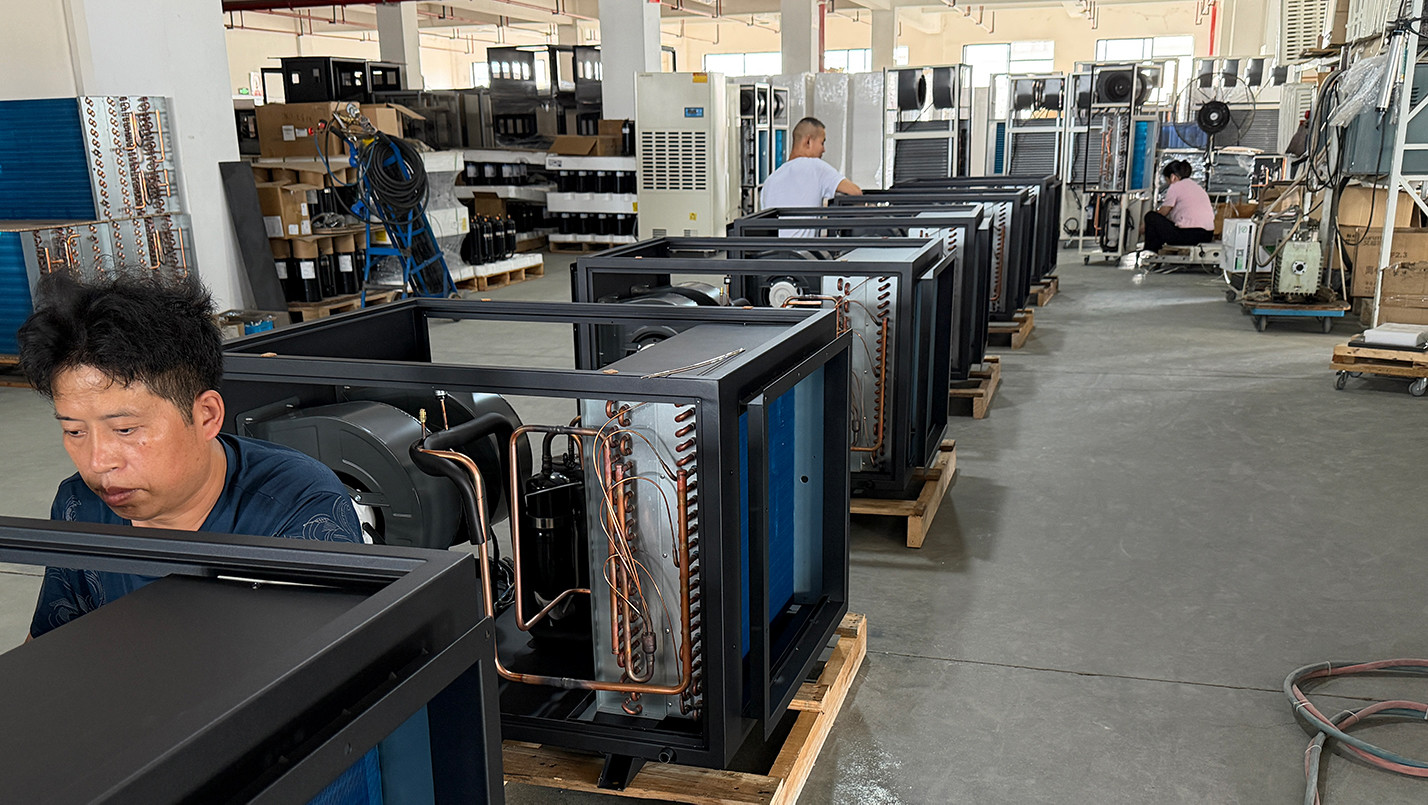
Industrial dehumidifier assembly workshop — East Dehumidifier, Hangzhou, China.
6. How to Run a Factory Visit
You do not need to fly to China to run an effective visit — a structured live video call gets you most of the way, and an in-person or third-party audit gets you the rest.
Before you go (or dial in)
Collect documents in advance: business license, export license, ISO and product certificates, and recent test reports. Agree the scope — which product lines, which shift, which areas — and book 4–8 hours for a medium-sized factory. Bring a quality engineer and a purchasing lead if you have them.
On the floor: what to actually look at
- Machinery and serial numbers. Ask for the equipment list and check key machines against it.
- Maintenance and calibration logs. Look for preventive-maintenance schedules and current calibration stickers.
- Quality checkpoints. Confirm IQC, IPQC and FQC are visibly in operation, not just written in a manual.
- Traceability. Can raw materials be traced to finished units? Is there a golden-sample or reference-sample store?
- Labor and safety. PPE in use, fire exits clear, working hours and payroll records available.
After the visit: the audit report
Write up non-conformances, evidence and a risk rating, then require a corrective-action plan with deadlines. For serious issues, schedule a re-audit. A factory that welcomes this process is, on its own, a strong positive signal.
Production line at the EAST facility in Hangzhou, China — units are run at rated load before dispatch.
7. Why "Hangzhou + OEM" Is a Buying Signal
There is a subtler reason the cluster matters: the combination of a real manufacturing ecosystem and a contract-manufacturing culture is itself a quality signal that an isolated factory cannot offer.
Competition keeps standards honest
When dozens of contract dehumidifier makers operate within a few square kilometers, pricing, quality and lead times are constantly benchmarked against each other. A factory that underperforms loses business to a neighbor. For a buyer, that competition does part of your vetting work for you.
Depth of the component base
An OEM factory is only as good as its suppliers. The Hangzhou cluster's dense base of compressor, heat-exchanger, rotor and controls vendors means a contract maker can source proven components quickly and substitute them when a spec changes — something an isolated factory, locked to a single supply route, cannot do as easily.
When to still choose a global brand
Objectivity matters here. European and North American names like Munters and Bry-Air still lead in certain ultra-specialized niches — for example, the most demanding low-dew-point desiccant systems, deep engineering support for one-off mega-projects, and long-standing brand trust with conservative buyers. If your project needs that specific assurance and budget is secondary, a global brand remains the right call. But for most distributors, private-label builders and project contractors, the Hangzhou cluster delivers the same core performance at a materially lower landed cost and a fraction of the lead time. For more on how customization works on our side, see our OEM/ODM customization service.
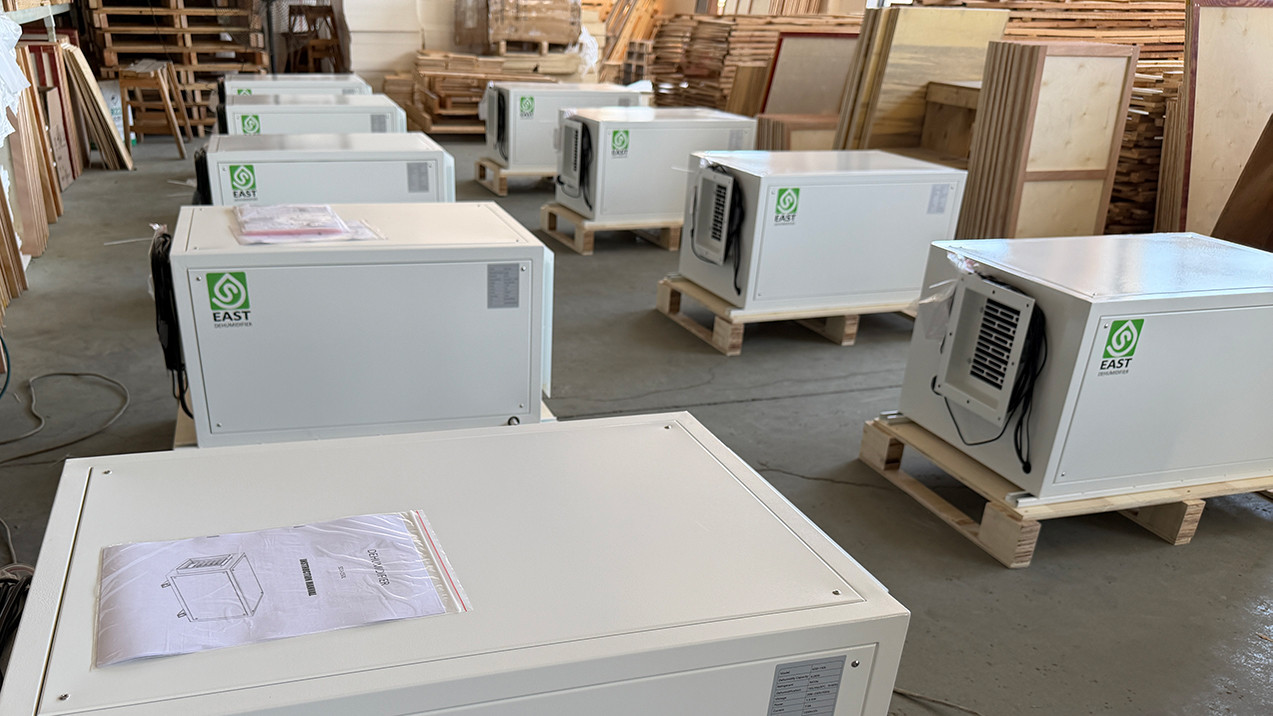
A finished EAST industrial dehumidifier unit, ready for export dispatch.