VPD Demystified: Humidity Control for Commercial Grow Rooms
- Share
- publisher
- East Dehumidifier Technical Team
- Issue Time
- Oct 22,2026
Summary
A practical guide to VPD-based humidity control in commercial grow rooms: what VPD measures, stage-by-stage targets, why night-time is the hard part, transpiration-based dehumidifier sizing, and how closed-room operation cuts energy 30-50%.
Two identical grow rooms can both read "60% RH" and produce very different crops — one thriving, the other covered in powdery mildew or, worse, bud rot. The difference is almost never the dehumidifier. It is what the grower is actually steering by. Relative humidity alone ignores temperature, which is why modern commercial cultivation runs on a single number that folds both together: vapor pressure deficit (VPD). This guide explains what VPD really measures, the target values by growth stage, and how to size and control a grow room dehumidifier around it.
1. What VPD Actually Measures
VPD is the difference between how much water vapour the air could hold at the leaf surface and how much it currently holds. In plain terms, it is the “pulling force” the air exerts on the plant — how hard the plant must transpire to stay hydrated. It is measured in kilopascals (kPa).
The standard calculation is:
VPD = SVP(leaf) − SVP(air) × (RH ÷ 100), where SVP is saturation vapor pressure at a given temperature. A common approximation for SVP is the Magnus–Tetens equation, SVP = 0.6108 × e(17.27 × T ÷ (T + 237.3)) with T in °C.
Why this matters more than a humidity setpoint: the same 60% RH means something entirely different at 21°C than at 27°C, because warm air holds far more moisture at the same percentage. VPD captures both in one number.
- Low VPD (air too humid). The deficit is small, so transpiration slows, stomata close, and nutrient transport stalls. The real danger is disease: persistently wet leaves are where Botrytis (bud rot) and powdery mildew start.
- High VPD (air too dry). The deficit is large, so plants dump water faster than roots can replace it. Leaves curl and crisp, stomata close defensively, and calcium stops moving to new growth — showing up as tip burn and blossom-end-rot-like symptoms.
Leaf temperature, not room temperature
The VPD that drives the plant is at the leaf surface, not the wall sensor. Transpiration cools the leaf, so leaf temperature drifts away from air temperature depending on your lights:
| Light type | Leaf temperature vs air | Why it matters |
|---|---|---|
| LED | Typically 2–5°F (some report up to 4–8°F) cooler | Little infrared heat; leaves run cool, so air-temp VPD reads too low |
| HPS / HID | Typically 2–5°F warmer | Radiant heat raises leaf temp, so air-temp VPD reads too high |
| CMH | Roughly equal | Smallest offset of the three |
Leaf-temperature offsets by lighting type (ranges reported across Quest, Pulse and TrolMaster guidance).
The error is not trivial: because saturation vapor pressure rises exponentially with temperature, a ~6°F (about 3°C) leaf-temperature error can shift VPD by 0.4–0.6 kPa — enough to move you out of the target zone entirely. Measure leaf temperature with an infrared thermometer aimed at a mid-canopy leaf, not at the room.
2. The VPD Target Map by Growth Stage
A seedling has a small root system and cannot replace water lost through its leaves, so it wants a low VPD (humid air). A dense flowering canopy wants a higher VPD (drier air) to keep buds from trapping moisture. The target drifts up as the plant matures. These are the ranges most commercial cannabis and greenhouse references converge on:
| Growth stage | VPD (kPa) | Typical RH | Typical temperature |
|---|---|---|---|
| Clone / seedling | 0.4 – 0.8 | 65 – 80% | 72 – 80°F (22 – 27°C) |
| Early vegetative | 0.8 – 1.0 | 60 – 70% | 76 – 80°F (24 – 27°C) |
| Late vegetative | 0.8 – 1.2 | 55 – 70% | 75 – 82°F (24 – 28°C) |
| Early flower | 1.0 – 1.4 | 50 – 60% | 75 – 80°F (24 – 27°C) |
| Peak / late flower | 1.2 – 1.6 | 40 – 50% | 70 – 78°F (21 – 26°C) |
| Final flush / pre-harvest | 1.5 – 2.0 | 35 – 45% | 70 – 75°F (21 – 24°C) |
| Drying / curing | ≈ 0.8 | ≈ 60% | ≈ 60°F (15.5°C) |
VPD target ranges by growth stage. Values are consensus ranges from multiple cultivation references, not a single-vendor specification — confirm against your cultivar and genetics.
For context, the classic greenhouse rule of thumb is that most plants grow well in a VPD of 0.8–0.95 kPa, with an acceptable greenhouse span of roughly 0.45–1.25 kPa. The staged numbers above are the crop-specific refinement that matters for a commercial room, because a grow room is run much tighter than a greenhouse.
One warning embedded in most guides: the VPD number that maximises transpiration is not always the number that maximises bud quality, aroma or terpene retention. Treat the table as a starting band, then tune to the phenotype — the plant's behaviour, not the chart, is the final referee.
3. Why Night-Time Is the Hard Part
Most humidity failures happen after lights-out. When the lights switch off, air temperature drops — growers often run a ~10°F (about 8°C) day–night differential — and because the same moisture in cooler air is a higher relative humidity, RH climbs sharply even though nothing new was added.
The moisture itself does not stop: plants keep transpiring through the dark period. When that moisture meets a cooling canopy, it condenses on leaf surfaces. Research from Wageningen University quantifies the load clearly: a lit greenhouse crop can release about 125 g/m²/hour, falling to roughly 25 g/m²/hour at night — and condensation on plant surfaces accounts for the overwhelming majority (on the order of 88–89%) of night-time moisture removal in a closed house. That condensation is precisely where botrytis and powdery mildew take hold.
The night-load design condition
Two practical consequences follow:
- The dehumidifier must carry the night load. A unit sized for lights-on transpiration is often under-loaded during the day and overloaded at night. Night-time is the true design condition.
- It must keep working as temperature falls. Condensing units lose capacity and can ice up as the coil approaches freezing. For a room that dips to 18°C (64°F) or below at night, choose a unit that holds rated performance at low temperature and has automatic defrost — otherwise the dehumidifier "goes on holiday" exactly when you need it most.
Good air movement is the cheapest dehumidifier you can buy: uniform circulation keeps the leaf boundary layer thin and stops cold spots from forming, which is why many operators pair the dehumidifier with canopy-level circulation fans rather than buying a bigger machine.
4. Latent Load From Transpiration
In a planted grow room, the crop is the dominant moisture source — far larger than infiltration or people. So sizing starts from biology, not from room volume. The most reliable way to estimate the latent load is by canopy area rather than plant count, because a dense 9-square-foot plant transpires like nine 1-square-foot plants of the same leaf density.
| Reference basis | Transpiration rate |
|---|---|
| Low-density canopy | ≈ 0.5 – 0.7 L/day per m² of canopy |
| High-density / high-PPFD canopy | ≈ 0.7 – 1.5+ L/day per m² of canopy |
| Per-square-foot rule of thumb | ≈ 1 – 3 pints/day per sq ft of canopy |
| Peak stage (flower / mother) | ≈ 2 pints/day per sq ft of canopy |
| Peak stage (vegetative) | ≈ 1.5 pints/day per sq ft of canopy |
Canopy-based latent-load references (ranges compiled from greenhouse dehumidification guides and cultivation HVAC guidance).
Two things that keep sizing honest
First, timing matters more than the daily total: in flower, roughly 80% of the daily load lands in the 12-hour lights-on window; in veg and mother rooms, roughly 90% lands in the 18-hour window. Size for the peak hour, not the 24-hour average.
Second, beware of an inflated number that circulates widely — a "0.5 kg per plant per hour" flowering figure. The Australian greenhouse-dehumidification literature traces that figure to two conference presentations (one by a dehumidifier manufacturer) and notes it is not a measurement, and is about four times the measured peak of 125 g/m²/hour for a lit crop. If someone sizes your room from a number like that, ask where it came from.
5. Sizing a Grow Room Dehumidifier
Work the load, add a safety factor, then stage the machines.
A worked example, in late flower
- 120 plants × ~0.7 gallon/day per plant ≈ 84 gallons/day.
- 1 gallon ≈ 8 pints, so 84 gallons ≈ 672 pints/day of transpiration.
- Add a 20–30% safety factor for lights-on spikes and system aging → ~840 pints/day of installed capacity.
- Deliver it as two staged units (e.g. 2 × 400–500 pints/day) rather than one giant, for redundancy and better part-load behaviour.
Read the capacity curve, not the name
Dehumidifier ratings are taken at a standard condition — commonly 80°F and 60% RH. Run the same unit in a drying room at 65°F and 50% RH and it can deliver less than half its nameplate pints-per-day. North-American units in this class are often named by that rating — a "Quest 506" or "Anden 710" denotes 506 or 710 pints/day at standard conditions — so always check the capacity curve at your setpoint.
On the product side, horticulture-specific dehumidifiers now span a wide band. Altaqua's grow-room range, for example, runs from 680 to 4,430 m³/hr of supply air and 78 to 597 L/day (at 27°C / 60% RH), with ±3% RH control accuracy, operation down to 18°C (64°F), automatic defrost, and optional R32 / R410A / R454B refrigerant. That low-temperature operation and defrost matter precisely because of the night-time problem in Section 3.
For ceiling-mounted configurations that keep floor space clear for canopy, see our ceiling mounted dehumidifier range, and for the full climate strategy, our indoor cultivation temperature and humidity control solution.
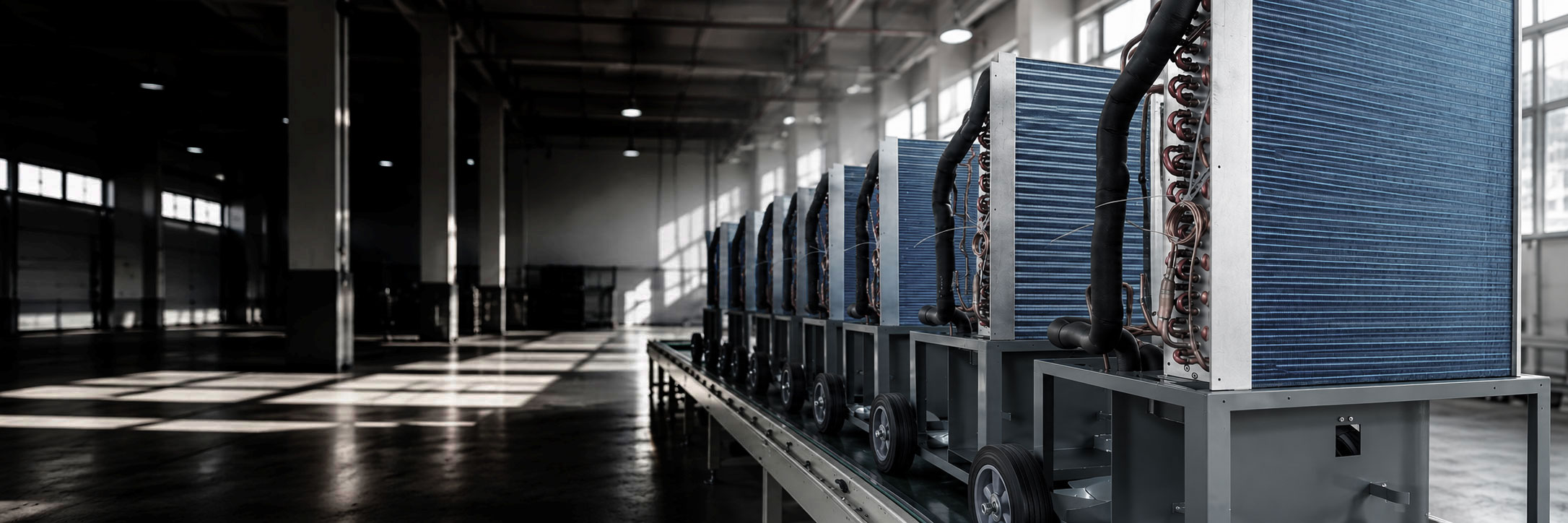
Commercial dehumidifier units on the production line — sized and factory-tested against their rated moisture removal before dispatch.
6. Energy: Cutting 30–50%
Dehumidification is one of the biggest electrical and HVAC loads in a commercial grow. The good news is that the savings are well documented — and most of them come from how you run the room, not just which machine you buy.
| Lever | Typical saving reported |
|---|---|
| Right-sizing (no oversized unit) | Avoids short-cycling and part-load waste; an oversized HVAC/dehumidification system can be 50–100% too large if sized from irrigation volume instead of canopy load |
| Closed-room operation (no venting to dump humidity) | Greenhouse/horticulture references report 50% average energy savings, up to 70% in favourable cases, versus heating-and-venting |
| Uniform air circulation | Even climate means less fanning, less reheating and less dehumidification to correct cold spots |
| Staging + part-load control | Multiple smaller units modulate with load instead of one machine cycling |
| Efficiency of the machine itself | Modern horticultural units extract ~4.5 L of water per kWh (e.g. ~45 L/hr on ~10 kW) |
Energy-saving levers and the savings ranges reported by horticultural dehumidification suppliers (DryGair, Conservant Systems) and cultivation HVAC guidance.
DryGair, which builds horticulture-specific units, is the most-quoted example: their systems extract about 45 L/hr on roughly 10 kW (about 4.5 L/kWh) and report average energy savings of 50% (up to 70%) against heating-and-venting. A grower-run study across three seasons in basil greenhouses in Germany measured 57% average energy savings and a payback of about 1.9 years on energy alone. Conservant Systems reports reducing RH-control energy by 40%+ in the same direction. Even the simple act of keeping the room sealed instead of venting moisture has a compounding benefit: it retains heat and keeps CO² levels up to roughly twice a conventionally vented room.
The takeaway is not "buy one brand." It is that closed-room dehumidification + right-sizing + circulation is where the 30–50% lives, and the machine is only one term in that equation.
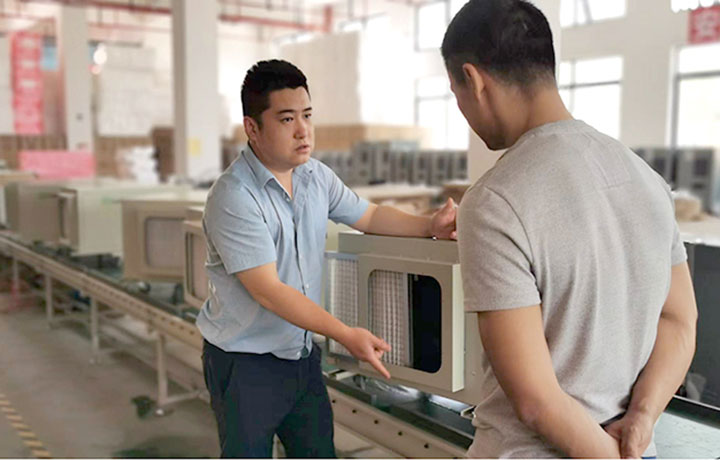
Every unit is factory-run before dispatch, so its real-world moisture removal is verified against the spec — not just the nameplate.
7. Controls: Setpoint vs VPD-Based
Setpoint control
A plain setpoint controller holds one number — say 55% RH — and switches the unit on and off around it. It is simple and reliable, but it ignores that "55% RH" is a different VPD at 20°C than at 28°C.
VPD-based control
VPD-based control instead keeps the plant's target deficit fixed and lets the controller trade temperature against humidity to hold it. This is more accurate for plant physiology, but it is also more demanding: it needs a leaf-temperature input, an RH sensor at canopy level, and actuators for both temperature and humidity. The two approaches are not enemies — most facilities run a VPD target in the controller and a humidity setpoint as a hard floor/ceiling for safety.
The LED shift and integration
Two modern factors push growers toward smarter control:
- The LED shift. LED rooms run with higher relative humidity and cooler leaves, because there is less infrared heat to evaporate moisture. A controller calibrated for HPS behaviour will misread an LED room — another reason leaf-temperature correction matters.
- Integration and fail-safes. Grow-room units now commonly expose a 24V signal for third-party controllers like TrolMaster, WiFi remote monitoring, auto-restart after a power cut, and automatic defrost. Those features are not convenience; they are what keep the night-time dip from turning into a mildew event while nobody is on site.
Whichever control mode you pick, the sensor placement decides whether it works: measure at canopy level, 6–12 inches above the tops, not at a wall or near an exhaust port — a wall sensor can read a different climate than the one your plants are actually standing in.

A finished commercial dehumidifier unit — controls and defrost matter as much as raw capacity in a grow room.