What power supply does a hand push industrial dehumidifier require?
- Share
- Issue Time
- Sep 28,2026
Small hand push units run on single-phase 220 to 240 V at 50 Hz, drawing roughly 1 to 4 A. Above about 150 litres per day you need three-phase 380 to 415 V, where a 192 litre machine draws 6.5 A at 3.5 kW and a 1,200 litre machine draws 38 A. Voltage, frequency and plug type are fixed per destination before the machine is built.
Four checks before you order
Let capacity decide the phase
Single-phase 220–240 V covers most units up to roughly 90–168 L/day. Above that the compressor and fan loads move to three-phase 380–415 V: published ranges show 168 L/day at 220 V drawing 4.3 A, 720 L/day at 380 V drawing 22.8 A, and 1,200 L/day drawing 38 A. North American sites usually specify 460 V three-phase 60 Hz, with 208–230 V and 277 V variants also available.
Size the circuit, not just the machine
Running current is the figure on the plate; the circuit has to cover it with margin. A 3.5 kW machine on 230 V single-phase draws about 15 A, which is above a 13 A plug and needs a 16 A industrial socket on its own circuit. Motor starting current is higher again, and long extension reels add voltage drop — a common cause of nuisance trips on job sites.
Fix the plug standard
Units are usually shipped with an industrial plug or with no plug at all, because the socket standard differs by market: CEE and IEC 60309 types in most of Europe and Asia, NEMA configurations in North America. Specify it at order. Adapters on a 20 A load are not a plan.
Confirm voltage and frequency for the destination
Most machines are listed at 220 V/380 V, 50/60 Hz, but the build is not automatically dual-rated — frequency changes motor and fan speed, which changes airflow and capacity. Confirm both at order, confirm the site tolerance is inside the usual ±10 percent band, and check phase rotation on three-phase units, because a reversed fan moves no air.
What the nameplate figures look like in practice
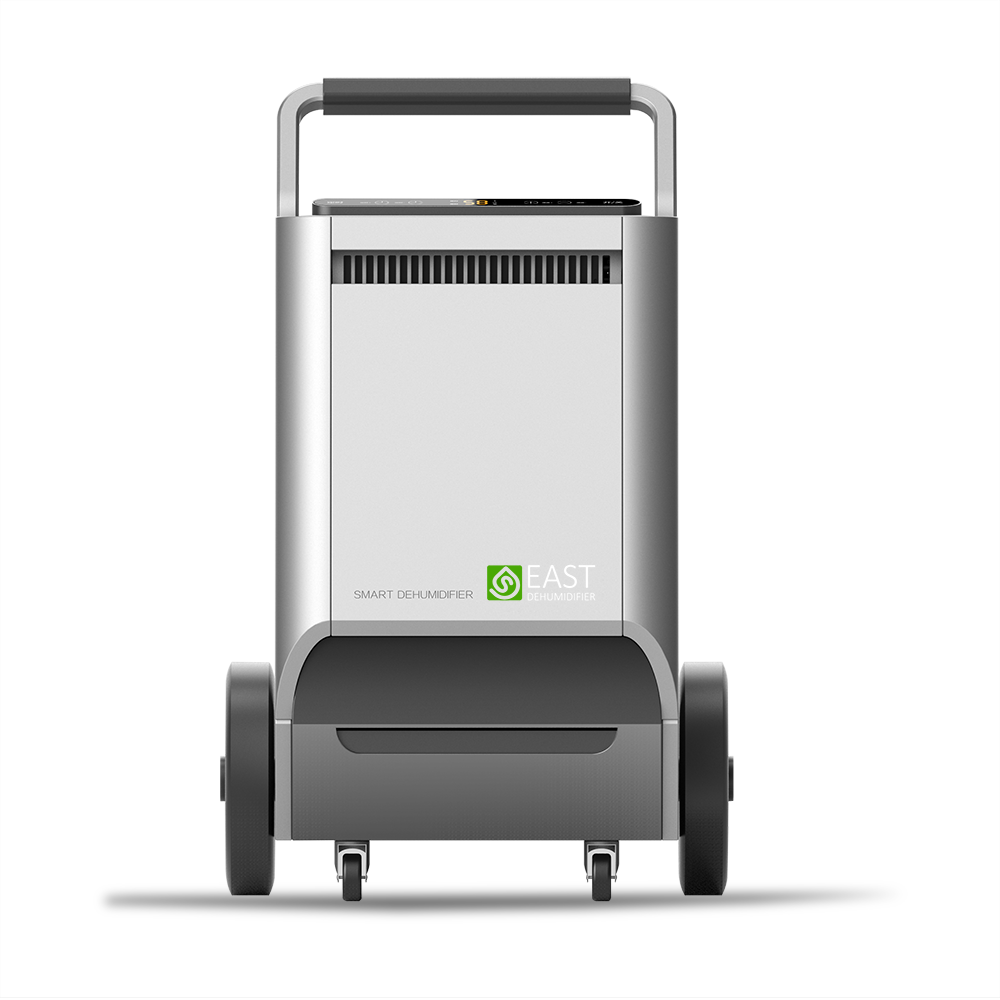
Current climbs faster than capacity, which is what catches people out. A 168 L/day machine at 220 V draws 4.3 A and will run from a normal industrial socket. A 240 L/day machine at 380 V draws 8.3 A at 4.8 kW. By 720 L/day you are at 22.8 A and by 1,200 L/day at 38 A, which is a dedicated three-phase supply with correctly sized protection, not something you plug into whatever is nearby.
Power and capacity also move together in a way worth knowing when you are costing a job: the large three-phase frames draw 12–21 kW at 720–1,440 L/day. At industrial tariffs the electricity, not the purchase price, is usually the larger line over a few years of continuous drying.
The other specification that gets missed is ambient. Portable condensing units are generally rated to work between 5 and 38 °C; below that the coil ices and the machine defrosts instead of drying, which is why winter restoration work either accepts the loss or moves to desiccant. Restoring a cold building therefore changes the power question as well: more machines, or a different technology.
Earthing and residual current protection are non-negotiable on portable plant that gets wheeled through wet areas, and the supply should be checked before each move rather than assumed from the last site.
Representative project configuration
A restoration contractor ran a mixed fleet across sites where the only certainty was that the supply would be unknown until arrival. The fleet was specified so that the smaller machines could always be deployed, with the larger ones held for sites with confirmed three-phase.
The operating rule came out of the arithmetic: with 168 L/day machines rated at 4.3 A and the 240 L/day frame at 8.3 A on three-phase, the fleet carries its own 16 A industrial leads and a phase tester, and jobs with only domestic 13 A sockets are served by the 90 L/day units. East Dehumidifier builds to the destination supply — voltage, frequency and plug are confirmed on the order, not discovered on site.
Supply requirements by capacity band
| Capacity band | Supply | Rated power | Running current | Typical connection |
|---|---|---|---|---|
| Up to 90 L/day | 220–240 V, 1-phase, 50 Hz | 0.45–1.5 kW | 2–7 A | 16 A industrial socket |
| 90–168 L/day | 220–240 V, 1-phase, 50 Hz | 1.5–2.8 kW | 4.3–7 A | 16 A industrial socket |
| 168–480 L/day | 380–415 V, 3-phase, 50/60 Hz | 2.8–10 kW | 7–22.8 A | CEE 16 A or 32 A |
| 480–1,200 L/day | 380–415 V, 3-phase, 50/60 Hz | 10–25 kW | 22.8–38 A | CEE 32 A or 63 A |
| North America | 460 V 3-phase 60 Hz, or 208–230 V / 277 V | By model | By model | NEMA, per local code |
Treat the bands as a starting point: the plate on the machine governs, and the same nominal capacity can differ by 10–20 percent between manufacturers depending on compressor and fan selection. The two things never to assume are that a 50 Hz machine is happy on 60 Hz, and that a plug adapter solves a socket mismatch on a 20 A load. East Dehumidifier confirms voltage, frequency, phase and plug on the order and states the ambient band the machine is rated for, so the supply is settled before delivery.
Related questions
Unsure what supply you have?
Send available voltage, phase, frequency and socket type plus the capacity you need. East Dehumidifier will match the machine to your supply and confirm the plug standard on the order.